Monocentropus
- Nov 14, 2025
- 2 min read
There is one species in this genus, M. balfouri.
Monocentropus balfouri
Common name: Socotra Island Blue Baboon Tarantula (often shortened to Socotra Blue Baboon)
Origin: Endemic to Socotra Island, off the coast of Yemen in the Arabian Sea.
Lifestyle: Old World, terrestrial / opportunistic burrower that creates heavy webbing and often forms complex tunnel systems. One of the few tarantulas known to thrive in true communal groups under the right conditions.
Adult size: Medium-sized tarantula, typically around 4.5–6 in (11–15 cm) diagonal leg span as adults.
Growth rate: Medium – slings and juveniles put on size steadily and can mature in a few years with warm temperatures and regular feeding.
Temperament: Typical Old World attitude—fast, alert, and defensive if provoked, with a strong threat display and a willingness to bite if pushed. Not suitable for handling, but many keepers find them relatively calm when left undisturbed and well-established in their web system.
Color & appearance:
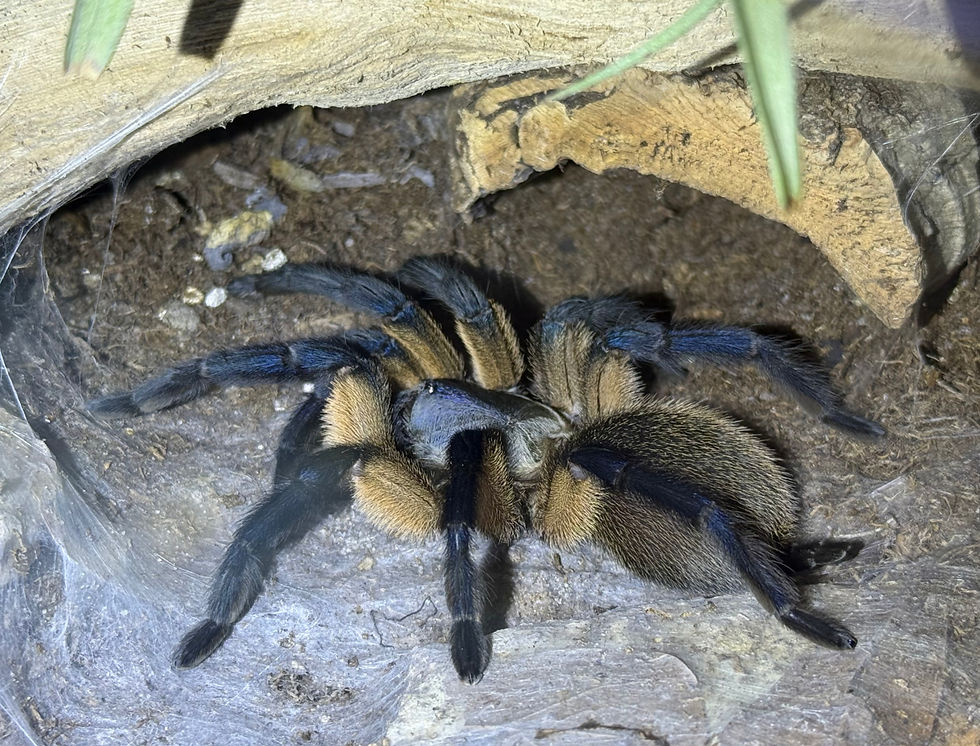
Striking contrast of metallic blue legs with a silver-blue carapace.
Cream to tan abdomen often with darker striping or mottling.
Spiderlings start out grey/brown and gradually develop their dramatic blue and cream adult colors over several molts.
Species History
Monocentropus balfouri, better known as the Socotra Island Blue Baboon, was first described in 1897 by British arachnologist Reginald Innes Pocock from specimens collected on the remote island of Socotra in the Arabian Sea. The species name balfouri honors botanist Isaac Bayley Balfour, who led expeditions to Socotra and supplied much of the material Pocock worked from.
This tarantula is endemic to the Socotra Archipelago (part of Yemen), where it inhabits hot, arid, rocky valleys and crevices. Isolated evolution on the island has produced its striking blue and cream coloration and unusual social tendencies: in nature and captivity, M. balfouri is one of the few tarantulas known to tolerate—and even thrive in—communal family groups with prolonged maternal care.
For much of the 20th century, M. balfouri remained a little-known island species, but over the last few decades it has become one of the most sought-after Old World tarantulas in the hobby, prized for its color, heavy webbing, and stable communal setups. A recent taxonomic revision confirmed just how distinctive it is, restricting the genus Monocentropus to a single species—M. balfouri—and moving its former congeners into a separate genus.
Natural Habitat
Endemic to the remote Socotra Archipelago of Yemen, Monocentropus balfouri lives in hot, arid rocky landscapes shaped by seasonal winds and sparse rainfall. On the island it is typically found in dry wadis and hillsides between roughly 50–400+ meters elevation, sheltering in rock crevices, under stones, or in shallow burrows that it lines heavily with silk.
Temperatures in its native range are warm year-round, with daytime highs often around the upper 20s to mid-30s °C (80s–90s °F), low humidity, and only modest annual rainfall. This challenging environment has shaped M. balfouri into a hardy, opportunistic terrestrial tarantula that uses webbing and available rock structure to create secure retreats rather than deep, permanent burrows.
Our Specimen:
Given name: Athena
Sex: Female
Life stage: Adult
Approximately 6 inches
Turned a bit "spicy" after her molt
Beautiful specimen; among my favorites

Our Specimens:
5 slings in a communal


Comments