Grammostola
- Dominik Alexander
- Nov 20, 2025
- 5 min read
Grammostola is a South American tarantula genus established by French arachnologist Eugène Louis Simon in 1892. Today, around 20 recognized species are known from temperate and subtropical regions of Argentina, Bolivia, Brazil, Chile, Paraguay, and Uruguay, including several of the hobby’s most iconic “beginner” tarantulas such as G. rosea, G. pulchra, and G. pulchripes.
In the late 19th century, many South American tarantulas were being described and shuffled between genera. Simon erected Grammostola in 1892 to group a set of robust, ground-dwelling species with similar morphology, later designating Grammostola pulchripes (then described in 1891) as the type species. Over time, several older names and “mini-genera” (such as Lasiocnemus, Lasiopelma, Polyspina, Polyspinosa, and Sorata) were synonymized into Grammostola as taxonomists realized they were describing the same lineage under different labels.
Early descriptions were often brief and based on a handful of visible characters like color and size. For relatively uniform spiders like Grammostola, this led to a tangle of names and misidentifications—especially among Brazilian and Chilean species—because key diagnostic features (such as the shape of spermathecae and male palpal bulbs) weren’t described in detail. Modern authors have highlighted that this “morphological homogeneity” created long-standing confusion in the genus.
From the mid-20th century onward, large regional works and hobby literature tried to sort things out, but some names became entrenched in the pet trade even as scientific views shifted. A classic example is the Chilean rose group: names like G. spatulata, G. cala, and G. porteri circulated for decades before recent taxonomic revisions clarified the situation and synonymized several of these with Grammostola rosea, while also updating distributions of Chilean species.
In the 2000s and 2010s, researchers began using an integrative approach—combining detailed morphology, cladistic analyses, and distribution data—to clean up more than a century of accumulated confusion. Recent work has refined species boundaries (for example in G. pulchra and other Argentine and Brazilian species) and confirmed that Grammostola is a distinct, primarily temperate South American lineage with around twenty valid species as of current catalogs. This ongoing research underpins the names and localities used by breeders and keepers today, linking the spiders on hobby shelves back to over 130 years of taxonomic history.
Grammostola pulchra
Common Name: Brazilian Black Tarantula
Origin: A New World terrestrial species from the temperate grasslands and open scrub of southern Brazil and Uruguay, where it lives at ground level in shallow burrows or natural retreats.
Lifestyle: Terrestrial, opportunistic burrower. In nature it shelters under rocks, roots, and debris or in short burrows, emerging at night to ambush prey. In captivity it behaves as a classic “pet rock” with occasional exploratory walks and a strong feeding response.
Adult Size: Typically reaches 6–7 in (15–18 cm) legspan, with some females reported slightly larger.
Growth Rate: Slow-growing compared with many tarantulas; slings and juveniles may take several years to reach maturity, especially females, but reward keepers with exceptional longevity.
Temperament: Widely regarded as one of the calmest and most forgiving species in the hobby—typically docile, slow to anger, and reluctant to flick urticating hairs or bite, making it a popular choice for beginners and seasoned keepers alike.
Color & Appearance: A robust, heavy-bodied tarantula famous for its uniform, velvety jet-black coloration across the legs, carapace, and abdomen. Under bright light, the hairs can show a soft charcoal or bluish sheen, giving this species its “black velvet” reputation.
Species History
Grammostola pulchra, popularly known as the Brazilian black tarantula, was first described by Brazilian arachnologist Cândido Firmino de Mello-Leitão in 1921. Native to the grasslands and scrub of southern Brazil and neighboring regions such as Uruguay, this New World terrestrial species lives in burrows or natural retreats in warm, open habitats.
For decades G. pulchra remained a rarely seen but highly coveted spider. As tarantulas became more popular in the pet trade, its combination of deep velvet-black coloration, calm demeanor, and impressive longevity quickly gave it a reputation as a “holy grail” species, especially once wild exports from South America became more restricted and most animals in the hobby began coming from slow-growing captive-bred lines.
In recent years, modern taxonomic and genetic work has revisited Grammostola species from the pampas region, confirming G. pulchra as a valid species and clarifying its relationships to close relatives like G. anthracina and G. burzaquensis. These studies also helped highlight long-standing confusion in the hobby between true G. pulchra and the similar G. quirogai, which was only formally described in 2016 after years of “Brazilian blacks” from Uruguay and Argentina entering the trade under the same name.
Natural Habitat
In the wild, Grammostola pulchra comes from the South American Pampas—vast temperate grasslands and savannas spanning southern Brazil and eastern Uruguay. These open plains have a mix of short grasses, scattered shrubs, and compact, well-drained soils.
This species is a terrestrial, opportunistic burrower, spending most of its time in shallow self-dug burrows or natural retreats under rocks, roots, and fallen debris. The climate in its native range is warm with mild seasonal variation and moderate humidity, with periods of rain followed by drier spells—conditions that favor a mostly dry surface with slightly moist soil below, and cool, stable microclimates inside the burrows.
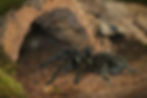
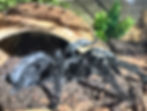
Our Specimen:
Given name: Celeste
Sex: Female
Life stage: Adult
Currently 6 inches in length
Beautiful dark beauty with a great personality.
Highly inquisitive and engaging. Always on display.
Has been in pre-molt for months


Pitella 2023
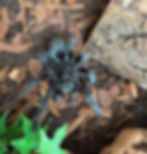
Genus and species: Grammostola pulchripes
Common name: Choco Golden Knee
Given name: Snickers
Sex: Undetermined
Life stage: Juvenile
The G. pulchripes (formerly known as G. aureostriata), a terrestrial species, is among the largest of the genus. Adult females may reach 8 inches. This species inhabits the grasslands of Argentina and Paraguay with dry spells and alternating periods of heavy rainfall. The enclosure should not be too humid. This is a very popular species in the hobby.
Habitat: Dry grasslands where they may build webs under rocks or in brush. Savannah, pampas grass.
Specimen Notes:
Approximately 3.5 inches
A little skittish and a generally pleasant demeanor.
Spends time in and out of its burrow.

Genus and species: Grammostola rosea
Common name: Chilean Rose (red variant)
Given name: Curry
Sex: Undetermined
Life stage: Sling
Historically, this species was among the most common in the hobby. However, there is habit-loss and poor trading activities, thus, prices have risen steeply. It is difficult to find an adult species.
Habitat: This species is from the high desert and scrubland regions of northern Chile, Bolivia, and Argentina. Terrestrial burrower.
Specimen Notes:
Approximately 1.75 to 2 inches
Great eater
Active and always visible. A great addition to the collection.


Genus and species: Grammostola rosea
Common name: Chilean Rose
Given name: Rose
Genus and species: Grammostola actaeon
Common name: Brazilian Red Rump
Given name: Claudia
Genus and species: Grammostola iheringi
Common name: Entre Rios
Given name: Vanessa